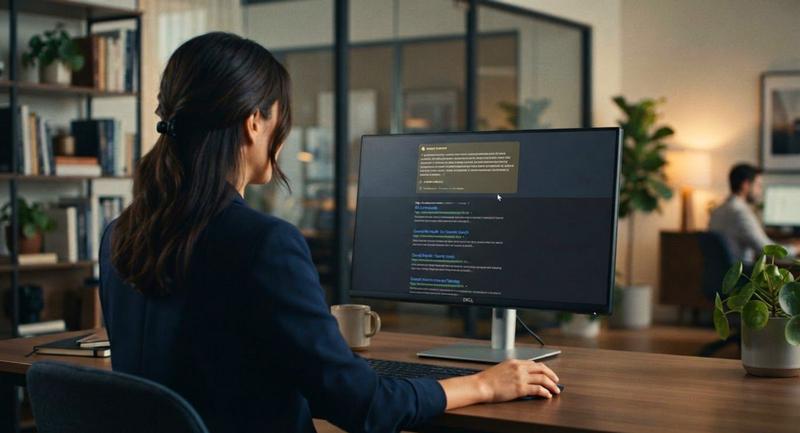
A graduate joined a marketing team in Mumbai this spring. On her second day, she was handed a brief and told to take a first pass at a campaign summary. She asked, quite reasonably, where the team's context lived. Which system held the brand's voice, the past campaigns, the reasoning behind the positioning. What she should connect her tools to.
There was a pause. Then someone pointed her to a shared drive, a folder named "FINAL_v3_USE THIS ONE", and a senior colleague who knows all that stuff but was on leave that week.
She did not complain. She did not raise it in her one-to-one. She simply looked at the team the way you might look at an office that still circulated memos by internal post. Polite. Slightly puzzled. Quietly recalibrating her expectations of the place she had just joined.
That look is coming for all of us.
How do Gen Z professionals experience AI differently from older workers?
We keep describing young professionals as AI-savvy, as though they attended a workshop the rest of us missed. That framing misses the point entirely.
A 22-year-old entering the workforce today was fifteen when generative AI became ordinary. They revised for exams with a thinking partner that never tired. They drafted, translated, summarised and argued with a machine through their entire academic life. They wrote university essays alongside a system that could challenge their structure before a tutor ever saw it. They have never known research as a solitary act, or a first draft that starts from a blank page.
Consider what that actually does to a person's assumptions about work.
If you have always had a second mind available, you stop thinking of knowledge as something a person owns. You think of it as something an environment provides. If you have always been able to test an idea instantly, you stop treating feedback as an event. You treat it as a constant. If you have never faced the blank page alone, the interesting question was never "can I produce this" but "is this worth producing".
For them, AI is not a tool they adopted. It is a condition of the world, like electricity or the internet. Nobody calls themselves electricity-savvy.
And people do not negotiate with the conditions of their world. They simply expect them. When a workplace fails to meet that expectation, they do not see a company with a technology gap. They see a company that has chosen to be slower than the world around it.
How have generational technology collisions reshaped workplaces before?
This has happened before, though we rarely remember it clearly.
When graduates who grew up with the internet entered offices in the early 2000s, they found workplaces that printed emails and kept knowledge in filing cabinets. Within a decade, the filing cabinets were gone. When the smartphone generation arrived, they found approval chains built around desks and office hours. Remote collaboration, chat-based work and asynchronous decision-making followed them in, not because leadership read a trend report, but because the incoming generation simply worked that way and the friction became embarrassing.
In each case, the pattern was identical. The institution assumed the newcomers would adapt. Instead, the newcomers exposed which of the institution's habits were principles and which were merely workarounds that had outlived their excuse.
The AI-native generation is the next collision, and it is likely to be the sharpest one yet. Because this time the gap is not about which tools people prefer. It is about how thinking itself gets done, stored and shared.
What they will actually expect
Not chatbots. Not an AI policy PDF. Not a lunchtime webinar on prompting. Something more structural, and more demanding.
They will expect context to be available, not oral. This generation has never had to reconstruct knowledge by asking whoever was in the room five years ago. They will find it absurd that a brand's voice, its decisions and its lessons live in the heads of senior staff and a graveyard of slide decks. To them, undocumented context is not tradition. It is negligence.
They will expect feedback in hours, not quarters. They learned with an instrument that responded instantly, endlessly, without judgement. They could attempt, fail, adjust and retry ten times in an evening. An annual review will feel to them the way a fortnightly letter feels to someone raised on messaging. This does not mean they cannot handle patience. It means they will not respect delay that exists only because the process was designed in 1987.
They will expect managers to be editors of judgement, not gatekeepers of information. The old apprenticeship model quietly assumed the senior person knew things the junior could not access. That asymmetry is gone. A first-year analyst can summon the same information, the same frameworks, the same precedents as their director. What remains, and what they will genuinely hunger for, is the thing machines cannot give them: taste, discernment, the ability to say this is technically fine and strategically wrong. A manager who offers only information will be respected roughly as much as a human search engine deserves.
They will expect to be judged on direction, not production. They can produce more in a day than their manager's first team produced in a month. They know it. Measuring them on output volume will feel like measuring a pilot on how fast they can walk. The metrics that will make sense to them are the ones that were always the honest ones: quality of decisions, clarity of thinking, outcomes owned.
And they will expect honesty about how work actually happens. They can tell when a company uses AI everywhere but pretends otherwise, and when a company bans it in policy while everyone uses it in private. Shadow usage reads to them not as caution but as hypocrisy. They would rather join a team that says openly: here is how we use these systems, here is where human judgement takes over, here is who is accountable.

The uncomfortable part for the rest of us
It is tempting to read all this as a story about accommodating the young. It is not. It is a story about what their expectations reveal.
Because everything this generation will demand is something we should have built anyway. Documented context. Fast feedback. Managers who teach judgement rather than hoard access. Evaluation based on thinking rather than typing. Honesty about how the work gets made.
We did not build these things because we did not have to. Scarcity protected us. Information moved slowly, so oral knowledge was acceptable. Production was hard, so output was a fair proxy for value. Expertise was locked in people, so hierarchy doubled as a filing system. None of this was wrong at the time. It was simply the best arrangement available under the old constraints.
The constraints have changed. The arrangements have not.
The new generation is not making unreasonable demands. They are simply the first people with no nostalgia for our workarounds. They never experienced the constraints that justified them, so they see our processes the way we would see a rule that no one can explain: as something waiting to be retired.
There is a second uncomfortable truth beneath the first. When an AI-native graduate joins a team and quietly underperforms, the instinct will be to question their attitude, their resilience, their generation. It will take longer to ask the harder question: whether we handed a fast mind a slow system and then blamed the mind.
The talent war will be fought over culture
The next decade's competition for talent will not primarily be fought over salaries or titles. It will be fought over working culture.
The best young minds will gravitate towards organisations where AI is woven into the fabric of how the team thinks, remembers and decides. Where the context is rich and reachable. Where seniority means sharper judgement rather than better access. Where they can do the best work of their lives without first serving an apprenticeship in institutional archaeology.
They will quietly avoid the ones where using AI still requires permission, apology or a folder named "FINAL_v3". And because they talk to each other, constantly and candidly, the reputation of a workplace's actual working culture will travel faster than any employer branding campaign can outrun.
They will be able to tell the difference within a week of joining. Possibly within a day. Almost certainly before their first review.
The institution adapts this time
Every previous generation entered work and adapted to the institution. This may be the first generation where the institution must adapt to them. Not out of generosity, and not out of fashion, but because the way they work is simply closer to how work will be done.
The organisations that thrive will not be the ones that attract young talent with beanbags and a licence to an AI tool. They will be the ones that took the arriving generation's expectations seriously enough to rebuild their foundations: where context lives, how knowledge is preserved, what managers are for, and what gets measured.
None of this requires prophecy. The generation is already here, sitting in induction sessions this quarter, asking polite questions about where the thinking lives and drawing quiet conclusions from the answers.
The graduate in Mumbai was not asking for special treatment. She was asking where the thinking lived.
Every organisation should be able to answer that question. Very few can.

Where Euryka stands
This is the generation Euryka is quietly building for.
A workplace where context is available rather than oral is not a cultural aspiration. It is infrastructure. Brand Hubs that hold the voice, the rules and the reasoning in one living system, so the newest person inherits the thinking, not just the files. Threads that preserve why decisions were made, turning every project into knowledge the next one can stand on. Governance that lets AI be woven into daily work openly, with accountability, rather than used in the shadows.
This is not about chasing a demographic. It is about building the workplace that the best people of every generation will soon consider normal.
When the next graduate asks where the thinking lives, the answer should not be a folder or a colleague on leave.
It should be a place.
Explore what that looks like at euryka.ai.