


The Experience Advantage.
Hospitality has recovered its demand. It has not yet recovered its margins, its talent pipeline or its control over the guest relationship. This paper is about where AI genuinely helps — and where it does not.


The Experience Advantage
Whitepaper
What this paper covers.
Written for senior hospitality and tourism leaders evaluating how to apply AI across the guest journey — hotel groups, resorts, tour operators, destination organisations and travel platforms.
Demand has returned. Margin, talent and the guest relationship have not.
International tourist arrivals reached approximately 1.52 billion in 2025, and Travel and Tourism contributed an estimated US$11.6 trillion to global GDP — nearly a tenth of the world economy.1,2 By any measure, people are travelling again. Yet the leaders running hotels, resorts, tour operations, destinations and travel platforms describe a familiar set of pressures: rising acquisition costs, persistent staffing shortages, guests who expect more and forgive less, and a technology landscape that produces more dashboards than decisions.
Into this environment has arrived a wave of AI adoption. Most of it is well intentioned. Much of it is disconnected. Research from McKinsey found that while 90 percent of surveyed travel organisations were using generative AI in some form, only 2 percent reported widespread, mature deployment.3 PwC found a nearly identical pattern in the Middle East, where 91 percent of hospitality and tourism leaders were piloting AI but only 3 percent had reached enterprise-wide use.4
The gap between experimentation and value is now the defining technology question in hospitality. This paper argues that the gap will not be closed by buying more tools. It will be closed by applying AI deliberately across the four stages of the guest journey: attracting guests with relevance, converting them with confidence, serving them with context and retaining them through continuity, with trust protected at every stage.
The organisations that solve it will not feel more automated to their guests. They will feel more attentive, because their people will finally have the time and the context to do what hospitality has always done best.
Figure 01 · Five findings
90% vs. 2%
Nearly every travel organisation is using generative AI. Almost none has reached mature, widespread deployment.3
One journey
Guests experience a single journey. Most hospitality businesses still manage several disconnected ones.
65% short
65 percent of surveyed US hotels reported staffing shortages; 71 percent had roles they could not fill.6
Continuity pays
A guest who explains a preference once and sees it remembered has a reason to book directly next time.
Context travels
Value depends on useful context reaching the right person at the right moment — in every segment.
Hospitality does not have an AI awareness problem. It has an AI usefulness problem.
One guest. Seven touchpoints. Nobody holding the thread.
A guest might discover a destination through a short video, research it through an AI assistant, compare prices across three online travel agencies, check reviews on two platforms, message the property on WhatsApp, book through whichever channel offered the best rate — and then expect the front desk to know everything they have already said.
-
Marketing knows one version of the guest. Reservations knows another. The property meets them with a name and a room number.
-
The programme records what the guest paid, rarely what the guest actually valued.
-
Repeating a preference at every stage is the clearest signal that no one is holding the thread.

The journey used to be linear. It has fractured into something far less tidy.
A traveller saw an advertisement or received a recommendation, visited an agent or a website, booked, arrived, stayed and, if all went well, came back. Today each of those steps has multiplied, and each is typically owned by a different system, team or third party. The organisation ends up holding several partial pictures of a guest who experiences only one journey.
This fragmentation matters more now for two reasons. The first is that discovery itself is changing. Travellers increasingly use AI tools to research trips, compare options and assemble itineraries. When an AI assistant summarises a destination or a property, it works from whatever information it can find. Hospitality brands that once competed for a position on a results page now compete for accuracy and distinctiveness inside an AI-generated answer. Deloitte's 2025 travel outlook notes that AI-assisted planning is moving steadily from novelty to habit, particularly among younger travellers.5
The second is that the economics of distribution keep tightening. Commission costs, advertising inflation and rate parity pressures mean the direct relationship with the guest has never been more commercially valuable. Yet building that relationship requires exactly what fragmented systems destroy: continuity. A guest who explains a preference once and sees it remembered has a reason to book directly next time. A guest who repeats themselves at every touchpoint has no such reason.
Figure 02 · Where the single journey splits
One relationship
Six disconnected systems
Context lost at every handover
Guests experience one journey. Most hospitality businesses still manage several disconnected ones.
In a 2025 survey by the American Hotel and Lodging Association and Hireology, 65 percent of surveyed US hotels reported staffing shortages and 71 percent had roles they were unable to fill.6 Fewer people are being asked to deliver more personal service across more channels. Something has to absorb the difference, and at present that something is usually the goodwill of overstretched teams.
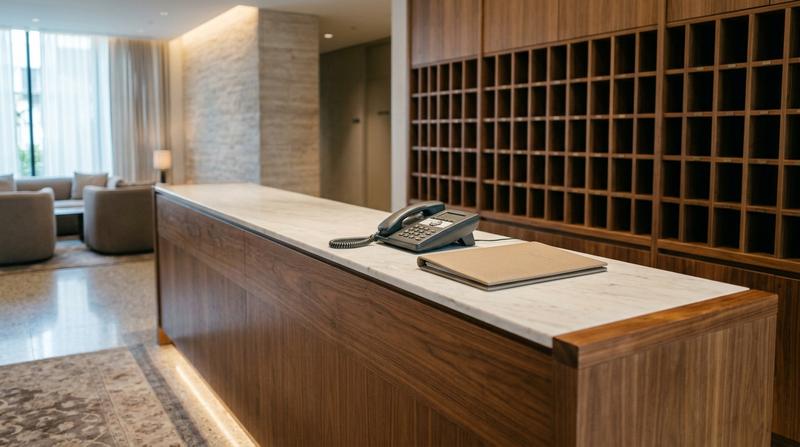
It would be convenient to blame the technology. The truth is less dramatic.
Most AI initiatives in hospitality fall short for organisational reasons, not technical ones. The tools generally do what they claim. What fails is the way they are placed into the business — as isolated additions rather than as a capability applied across a journey.
-
The chatbot does not know what marketing promised; the copilot drafts an email the property rewrites.
-
Effort concentrates on horizontal tools while the industry-specific work is left alone.3
-
When a tool increases the effort of delivering good service, people stop using it — and they are right to.
Five patterns repeat across the sector. None of them is a technology fault.
The most common is the isolated pilot. A chatbot is added to the website, a content tool is adopted by marketing, a copilot is rolled out to head office. Each solves a task, and each creates a new island. McKinsey's research is blunt on this point: travel companies have concentrated their AI effort on horizontal tools such as chatbots and copilots, while the high-value, industry-specific workflows remain largely untouched.3
Underneath sits a governance question of a particular kind. In an industry built on trust, where a single wrong detail about accessibility, pricing or availability creates real-world disappointment, checking after the fact is the wrong order. The OECD has been clear that consumer protection, transparency and data stewardship need to be designed into tourism AI adoption from the start, not retrofitted after complaints.7
Table 01 · Five patterns, and what each one costs
| Pattern | What it looks like | What it costs | The correction |
|---|---|---|---|
| Isolated pilots | A chatbot, a content tool and a copilot adopted independently | Each solves a task and creates a new island | Apply AI to a journey stage, not to a department |
| Fragmented guest context | Preferences recorded by one team, invisible to the next | Generic output that guests have learned to ignore | One shared context layer every workflow reads from |
| Technology that adds work | Toggling systems, verifying answers, re-entering data | Frontline teams quietly abandon the tool | Measure effort removed, not features shipped |
| Governance arriving late | Privacy, consent and accuracy checked after publication | Real-world disappointment in a trust-based industry7 | Standards enforced at the point of creation |
| Measurement by activity | Counting prompts, users and assets generated | Pilots drift until budgets tighten | Tie every use case to a commercial or service metric |
Personalisation is regularly announced and rarely delivered, because the information needed to personalise anything sits in silos. A property cannot act on a preference recorded by a call centre it cannot see. An AI system trained on incomplete context produces generic output, and generic output is precisely what guests have learned to ignore.
The final pattern is measurement by activity. Organisations count prompts, users and assets generated. Very few connect AI initiatives to conversion rates, response times, workload reduction or guest satisfaction. What is not measured commercially cannot be defended commercially, and so pilots drift until budgets tighten.
None of these failures is permanent. Each is a symptom of treating AI as a collection of tools rather than as a capability applied across a journey.
An AI pilot can look impressive in a presentation and still make little difference at reception.
Start with the journey. Apply AI only where it demonstrably helps.
Euryka approaches hospitality AI through a simple discipline: identify where relevance, speed or context breaks down, then intervene there and nowhere else. Four stages, with trust protected across all of them, each powered by a single workspace rather than a shelf of separate tools.
-
Brand knowledge, collaboration, content creation and governance live together.
-
Standards enforced at creation; judgement stays firmly with people.
-
Integrations and APIs extend into booking and CRM rather than replacing them.

Four stages on one rail — with trust running the full width beneath them.
The framework has four stages: attract with relevance, convert with confidence, serve with context and retain through continuity. Each is powered by the Euryka Platform, a single workspace where brand knowledge, team collaboration, content creation and governance live together rather than in separate tools. Governance is not a fifth stage bolted to the end; it runs underneath all four.
Figure 03 · The guest journey spine
Stage 01
Attract with relevance
Found, understood and preferred — across search, social, agencies and AI assistants.
Stage 02
Convert with confidence
Enquiries answered, proposals drafted, direct channels made compelling.
Stage 03
Serve with context
The stay itself — friction removed so warmth has room to show up.
Stage 04
Retain through continuity
Post-stay communication that references the actual stay, not the segment.
Figure 04 · The four stages as one continuous arc

-
Brand Hub
A living home for brand rules, tone, visual identity, property facts and market context
-
Threads & Personas
Context-rich collaboration with AI that already knows the brand, property and audience
-
Flows & Documents
Repeatable campaigns as visual pipelines rather than projects rebuilt each quarter
-
Collections & Grow
Approved assets organised and reusable; commercial teams prioritising who returns
Brands once competed for a position on a results page. Now they compete inside an answer.
The first stage concerns discovery. Hospitality brands must now be found, understood and preferred across search engines, social platforms, travel agencies and, increasingly, AI assistants. This requires a volume and variety of communication that most in-house teams cannot sustain manually — and, more importantly, a consistency of fact that no amount of manual effort reliably delivers once the same property is described in nine places.
On the platform, this work starts in the Brand Hub, so that every campaign, caption and description draws from the same source of truth. When an AI assistant assembles an answer about a property, the accuracy of that answer depends on the consistency of what the brand has published — which makes the source of truth a discovery asset, not just an internal convenience.
Figure 05 · What each capability does at this stage
One source of truth
Brand rules, tone, visual identity, property facts and market context in a living home rather than a slide deck. Every campaign, caption and destination description begins from the same verified foundation.
Visuals without a shoot per season
On-brand visuals and video concepts for seasonal variation, campaign testing and channel formats — explored inside an established visual world rather than commissioned from scratch each quarter.
Multilingual campaign copy
Property storytelling, destination guides and campaign copy produced in multiple languages from approved material, so a small central team can serve markets it could not previously reach.
Campaigns as reusable pipelines
Seasonal offers, festival promotions and recurring campaigns become visual, reusable workflows rather than projects rebuilt from scratch each quarter by whoever happens to be available.
Enquiries need answers. Group requests need proposals. Neither should be improvised.
The second stage concerns the distance between interest and booking. Direct channels need offers compelling enough to compete with third parties, and every hour that a group or event enquiry sits unanswered is an hour in which an online travel agency is answering instead.
Here, teams work in Threads — context-rich conversations where commercial, marketing and property colleagues collaborate with AI Personas that already know the brand, the property and the audience. Enquiry responses and group proposals are drafted from approved property information held in the Brand Hub, not improvised. Offers and direct-booking communication are assembled in Documents and Flows, carrying the brand voice because they are generated inside the brand's guardrails rather than beside them.
Generated inside the brand's guardrails rather than beside them.
Figure 06 · An enquiry, before and after
Whoever is free
- — Property facts retyped from memory or an old email
- — Tone varies by who happened to answer
- — Proposal rebuilt from the last similar one, errors included
- — Response time measured in days
Drafted from approved material
- — Property information loaded from the Brand Hub automatically
- — Persona holds the register for the audience and channel
- — Proposal assembled in a Flow the whole team can see
- — Human judgement on the commercial decision, not the typing

The purpose is not to replace warmth with automation. It is to remove what prevents warmth.
The third stage is the stay itself — the part of the journey where hospitality is either delivered or quietly missed. Almost nothing at this stage benefits from more automation. Almost everything benefits from the front desk being better informed than the guest expects.
-
A shared, searchable base of property, destination and guest-facing information.
-
The guest should not have to explain a preference a second time.
-
Voiceovers and multilingual generation in each guest's own language.
Service content produced centrally. Adapted per property, without being rewritten per property.
The platform gives property teams a shared, searchable knowledge base of property, destination and guest-facing information, so the front desk is never the least informed voice in the conversation. Pre-arrival communication reflects what the guest has already shared. Voiceovers and multilingual generation let a small team serve an international guest list in its own languages. Service content, from in-room guides to itineraries, is produced and updated centrally and adapted per property.
The distinction worth holding onto is between automating an interaction and removing the work that surrounds it. Nobody wants a machine to greet them. Everybody wants the person greeting them to already know that the anniversary was mentioned at booking, that the early flight means an early breakfast, and that the restaurant recommendation given last year was the right one.
Table 02 · Where friction sits during the stay
| Moment | Common friction | What context changes |
|---|---|---|
| Pre-arrival | Generic confirmation that ignores everything already shared | Communication that references the actual booking conversation |
| Check-in | The property meets the guest with a name and a room number | Preferences and prior stays visible to the person at the desk |
| In-stay enquiry | Staff searching several systems, or guessing | One searchable base of property and destination information |
| Language | Service quality varies with who is on shift | Multilingual generation and voiceovers available to the whole team |
| In-room material | Guides out of date the moment anything changes | Produced centrally, adapted per property, updated once |
Loyalty campaigns informed by preference — not blasted by segment.
The fourth stage begins when the guest leaves. Continuity means post-stay communication that references the actual stay, review responses that are prompt and personal, and loyalty campaigns informed by preference rather than blasted by segment. It is the stage most often delegated to a scheduled template, and the stage where the difference between remembering and recording is most visible to the guest.
Collections keeps every approved asset, message and campaign organised and reusable, so the next communication builds on the last instead of starting again. Flows automates the repeatable parts of post-stay engagement, while Grow capabilities help commercial teams identify and prioritise the guests and partners most likely to return. And because Euryka extends into the tools teams already use, through integrations and APIs, this continuity does not require replacing existing booking or CRM systems.
-
The stay that actually happened
Not the room type and the total on the folio
-
Preferences worth remembering
What the guest valued, distinct from what the guest spent
-
Every approved asset
Organised and reusable, so the next campaign builds on the last
-
The existing stack
Booking and CRM systems extended, not replaced
The goal is not to automate hospitality. It is to remove the work that gets in the way of hospitality.
The pressure points differ by business model. The underlying requirement does not.
A resort group worries about consistency across properties. A tour operator worries about the speed and accuracy of complex itineraries. A destination organisation worries about speaking to a dozen audiences in a dozen languages without dissolving its identity. The table below summarises where the framework lands in each segment.
Table 03 · The framework by segment
| Segment | Business pressure | Relevant application | Intended outcome |
|---|---|---|---|
| Hotel groups & resorts | Inconsistent experiences across properties | Shared knowledge, campaigns and review workflows | Greater consistency and faster execution |
| Luxury & boutique | High expectations for personal service | Context-aware guest communication | More relevant, distinctive experiences |
| Homestays & residences | Large, varied property portfolios | Property-specific content and guest information | Lower production burden and clearer communication |
| Tour operators | Complex itineraries and frequent changes | Proposal, itinerary and communication workflows | Faster responses and fewer manual errors |
| Destination organisations | Multiple audiences, partners and languages | Adaptable destination campaigns | Broader relevance without losing identity |
| Travel platforms | High enquiry and content volume | Structured content and service support | Faster handling and improved accuracy |
| Experiences & attractions | Seasonal demand and short booking windows | Timely offers and visitor information | Better conversion and capacity utilisation |
| Events & business travel | Complex proposals and stakeholder coordination | Sales support and proposal development | Shorter response cycles |
Two observations are worth drawing out of the table. The first is that none of these applications requires replacing the human elements of hospitality. The tour operator's travel designer still designs. The concierge still recommends. The general manager still walks the floor. What changes is the proportion of their day spent on assembly, formatting, searching and repetition.
The second is that the underlying requirement is identical in every row. Whether the organisation runs three boutique hotels or three hundred franchised ones, value depends on useful context reaching the right person at the right moment. The segments differ in vocabulary, not in principle.
Figure 07 · Three segments, three pressures

Consistency at distance
The standard is defined centrally and delivered locally, which is exactly where it drifts. Shared knowledge, campaign workflows and review processes let each property express the brand without reinventing it — and let the centre see what is actually reaching guests without becoming the final editor of every caption.

Complexity at speed
Itineraries change constantly, and every change ripples through proposals, supplier communication and guest documentation. Proposal and itinerary workflows shorten the response cycle and reduce manual error, while the travel designer keeps doing the part that clients are actually paying for.

Many audiences, one identity
A dozen audiences, a dozen languages and a network of partners each with their own interpretation. Adaptable campaigns let the destination speak differently to each without dissolving into a description that could apply anywhere — broader relevance without losing identity.
The use cases differ. The requirement does not: useful context must reach the right person at the right moment.
The distance from pilot to capability is shorter than most teams fear — provided the work starts in the right place.
It starts with a business bottleneck, not a technology wish list. Before selecting any use case, five questions deserve honest answers, and the honesty matters more than the speed.
Answer these before choosing a single use case.
- Where could better relevance genuinely improve discovery or conversion?
- Where in the journey is guest context currently lost?
- Which repetitive tasks consume the hours teams would rather spend on service?
- Which systems and information sources would need to connect for any of this to work?
- What privacy, accuracy and approval controls are required before the organisation will trust the output?

Euryka answers these questions with two connected offerings. The Euryka Platform is the everyday workspace: Brand Hub, Threads, Flows, Imaginations, Documents, Voiceovers, Personas and Collections, with governance and integrations built in. Euryka AI Studio is the expertise around it — the team that maps your guest journey, configures the platform to your operating reality, builds bespoke automations and stays embedded as the capability matures. The platform provides the system. The Studio makes it yours.
Table 04 · The five-phase Studio engagement
| Phase | Focus | Principal activities |
|---|---|---|
| Decode | Examine the journey honestly | Structured examination of the guest journey, the commercial pressures and current systems. Usually surfaces uncomfortable findings: preferences collected and never used, response times far longer than anyone assumed, content produced repeatedly because nobody could find the original. |
| Architect | Define the shared context | Brand Hub foundation, property and destination knowledge, priority Flows and governance requirements. Where decisions are made about what information AI systems may use, what remains private and where human approval is mandatory. |
| Design | Build working experiences | Campaign Flows, enquiry responses, service tools and post-stay communication, each built around the organisation's actual operating reality rather than a generic template. |
| Activate | Deploy small, measure properly | A deliberately small number of high-value use cases with real metrics: direct enquiry conversion, campaign development time, guest response times, hours of repetitive work removed, employee adoption and guest satisfaction. |
| Govern | Keep the capability honest | Performance, accuracy, adoption and risk reviewed on a regular cycle before anything expands. Use cases that pass review earn wider rollout. Use cases that do not are refined or retired without ceremony. |
Figure 08 · Where the effort sits across the five phases
Illustrative sequencing from Euryka's advisory work — phases overlap in practice, and Govern never ends. The proportions vary by organisation; the order does not.
Start with a business bottleneck, not an AI wish list.
Direct enquiry conversion. Campaign development time. Guest response times. Hours of repetitive work removed. Employee adoption. Guest satisfaction. Not prompts issued, users onboarded or assets generated.
Hospitality has always been the business of noticing. The question is how consistently you can act on it.
The best operators notice what a guest needs before it is asked for, notice when a routine has become a ritual, and notice the difference between a complaint and a cry for reassurance. No technology replaces that. The question is how consistently an organisation can act on what it notices, across every property, channel, language and shift.
That is what AI, applied with discipline, actually offers this industry. Not a robotic future, but an attentive one. The organisations that will benefit most are those that connect commercial performance, guest context, employee capability and responsible use into one coherent effort. They will not automate every interaction, and they will be deeply unimpressed by vendors who suggest they should. They will instead choose the places where technology removes friction, sharpens relevance or returns time to the people who serve.
The demand is there. The economics reward those who convert it directly and retain it personally. The technology is ready. What separates the leaders from the laggards now is not access to AI, but judgement about where it belongs.
-
Where context is lost
Mapped against your own guest journey, stage by stage
-
Which workflows create avoidable effort
The repetition your teams would rather not be doing
-
Where AI improves outcomes
Commercial or service, named and quantified
-
What integrations and controls are required
Before anything is trusted with a guest-facing decision
-
The first 90-day activation plan
Not a technology shopping list — an evidence-based sequence
The vocabulary this paper assumes.
The usefulness gap
The distance between AI experimentation and AI value. Nearly every travel organisation uses generative AI in some form; very few have reached mature, widespread deployment.3,4
Guest journey fragmentation
One guest experiencing a single journey while the business manages several disconnected ones — each touchpoint owned by a different system, team or third party.
Shared Context
Brand, property and guest knowledge that travels with the work rather than living in a single team's system — the condition on which every stage of the framework depends.
The four journey stages
Attract with relevance, convert with confidence, serve with context, retain through continuity. Trust is not a fifth stage; it runs beneath all four.
Trust spine
Governance designed into the work rather than inspected after it: standards enforced at the point of creation, approvals and pre-publish checks inside the platform, auditability on usage and outputs.
Studio phases
Decode, Architect, Design, Activate, Govern — the five-phase engagement through which the platform is fitted to an organisation's operating reality.
Isolated pilot
An AI tool adopted by one team in isolation. It solves a task and creates a new island — the most common reason hospitality AI initiatives stall.
Measurement by activity
Counting prompts, users and assets generated instead of conversion, response time, workload removed or guest satisfaction. What is not measured commercially cannot be defended commercially.
AI-assisted discovery
Travellers researching trips, comparing options and assembling itineraries through AI tools. When an assistant summarises a destination or property it works from whatever information it can find, so brands now compete for accuracy and distinctiveness inside an answer rather than for a position on a results page.5
Better hospitality does not begin with more technology. It begins with knowing where technology genuinely helps.
Not a robotic future. An attentive one.
The organisations that will benefit most are those that connect commercial performance, guest context, employee capability and responsible use into one coherent effort — and that are willing to be unimpressed by anyone selling automation for its own sake.
-
1.52 billion arrivals and US$11.6 trillion of economic contribution say the travellers are there.1,2
-
What separates leaders from laggards is not access to AI, but knowing where it belongs.
-
One assessment of your own guest journey, before any tool is chosen.

Start a Hospitality AI Readiness Assessment.
The most practical first step is a focused assessment of your own guest journey. The outcome is not a technology shopping list. It is a clear, evidence-based view of where the experience advantage lies in your business, and how to claim it.
References cited in this paper.
- UN Tourism, World Tourism Barometer, January 2026.
- World Travel & Tourism Council, Economic Impact Research 2025.
- McKinsey & Company and Skift, Remapping Travel with Agentic AI, September 2025.
- PwC Middle East, AI at the Heart of Tourism and Hospitality, December 2025.
- Deloitte, 2025 Travel Industry Outlook, 2025.
- American Hotel & Lodging Association and Hireology, hotel workforce survey, February 2025.
- OECD, Artificial Intelligence and Tourism, December 2024.
External statistics referenced in this paper are drawn from published global reports, listed above. Engagement-based observations are described qualitatively and attributed to Euryka's diagnostic and advisory work with hospitality and tourism leaders. Statements derived through reasoning without a direct source are framed as analysis rather than fact.