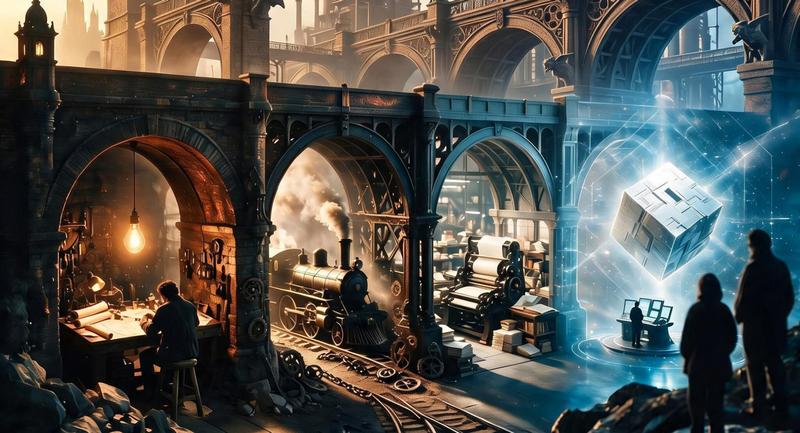
AI is becoming native to business faster than businesses are learning how to think with it. The distinction matters, because the two are easily confused.
Almost every large organisation now has access to generative AI. Stanford's 2026 AI Index puts organisational adoption at 88 per cent, with generative AI used in at least one business function by 70 per cent of organisations surveyed. Yet AI agents remain in the single digits across most functions.¹ The technology is moving rapidly into the organisation; its role within the organisation is still being worked out.
For most companies, the first instinct has been understandable: take what already happens and make it faster. Ask AI to write the report, summarise the meeting, analyse the customer data, produce the code, answer the enquiry or prepare the presentation. The organisation remains essentially the same. The machinery around it simply becomes more capable.
This is useful. It is also the least interesting thing AI could do for a business.
How Are Most Companies Actually Deploying AI Across Their Workflows?
Much of the current conversation about becoming AI-native is really a conversation about making existing work AI-assisted. The workflow stays intact. People stay in the same roles. Decisions move through the same hierarchy, the same metrics are measured and the same customers are served. AI removes some of the friction along the way, and everything else holds still.
McKinsey's research on the state of AI describes the same pattern. Companies are deploying AI widely, but most are accelerating existing activities rather than changing the operating model underneath them. Only 21 per cent of organisations using generative AI report having fundamentally redesigned at least some of their workflows, and workflow redesign turns out to be the single factor most strongly associated with AI having a measurable effect on earnings.²

There is a reason for the gap. It is considerably easier to give an employee a better tool than to question why the employee, the process or even the department exists in its current form.
But that is where the more consequential question begins. What happens when AI is no longer asked to fit the organisation? What happens when the organisation begins to change because AI exists?
What human intelligence still does that machines do not
There is a temptation to describe this as a contest between human and machine intelligence. That misses the more interesting distinction.
AI can analyse enormous bodies of information, identify patterns, generate possibilities and recombine knowledge at a scale no individual can match. Research on AI and innovation increasingly describes this as knowledge recombination: bringing together ideas and domains that previously existed separately. Recent work analysing US patents finds that inventions drawing on AI are markedly more likely to represent novel recombinations of existing knowledge than those that do not.³
But businesses do not run on the production of possibilities alone. Someone still has to decide which possibility matters. Someone has to question the premise on which the problem was defined, to recognise that the market being analysed is the wrong market, that the product being improved should not exist in its current form, or that an opportunity sits somewhere the organisation has never thought to look.
This is where human intelligence remains particularly important. Not because humans can produce more information than machines, or even because humans will always produce more novel combinations; AI can already do both remarkably well. The difference is that human intelligence can originate direction.
It can decide that the question itself is wrong. It can imagine a possibility before there is a dataset to support it. It can connect an observation to an ambition rather than to an existing body of knowledge. And it can decide that something is worth pursuing before the evidence is complete.
That is not simply creativity. It is the capacity to determine what should exist next.

Efficiency Is a Shared Gain, Not an Advantage
This is why the current productivity conversation may be too narrow.
If every company uses AI to write faster, analyse faster and produce faster, those gains eventually become available to everyone. A competitive advantage cannot rest on using the same intelligence slightly more efficiently than the company next door. There is even evidence that leaning on the same generative tools pulls outputs closer together: one controlled study found that writers given AI-generated ideas produced individually stronger work, but the collection of work as a whole became more similar.⁴ Efficiency, applied uniformly, tends towards convergence.
The greater opportunity is to use AI to expand the range of things the organisation can conceive, test and pursue. That requires a different relationship between human and machine intelligence.
AI can examine ten thousand possibilities where a team might previously have examined ten. It can challenge an assumption from several directions at once. It can simulate alternatives that would have been too expensive to investigate, and connect knowledge across departments that rarely speak to each other.
But the organisation still needs people capable of recognising when the answer has changed the question. That is where innovation begins.

What Does an AI-Native Company Actually Look Like?
An AI-native company should not be defined by how many employees use a chatbot, how many agents it has deployed or how much work it has automated. It should be defined by whether AI has changed the way the organisation thinks.
McKinsey's work on AI transformation draws a similar line. The organisations capturing the most value are not simply adopting more technology; they are the ones redesigning workflows, operating models and the way decisions are made, and they are roughly three times more likely than their peers to have undertaken a broad operating-model redesign.²
If that shift is taken seriously, the day-to-day shape of work changes.
A research team might no longer begin with a question and use AI to find the answer. It might begin with AI exploring thousands of possible questions, and humans deciding which ones deserve investigation. A product team might stop asking AI to improve the existing product and instead ask what entirely different products become possible given what the company now knows. A strategy team might spend less time producing analysis and more time deciding which assumptions are worth challenging.
The role of the human does not disappear. It moves.

How Should Businesses Reallocate Intelligence as AI Becomes Native?
The first phase of AI in business has largely been about augmentation: give people a powerful machine and let them do their existing work better. The next phase is more interesting. It is about the reallocation of intelligence.
Let machines do what machines are increasingly good at: processing, comparing, synthesising, testing and extending the enormous body of knowledge that already exists. Let humans spend more time on what organisations have historically struggled to do consistently: questioning assumptions, setting direction, making judgements and conceiving possibilities that are not obvious from the information already to hand.
The mistake would be to build AI into the organisation and leave the organisation unchanged. The opportunity is to allow the presence of AI to change what the organisation believes it is capable of doing.
AI becoming native to business, then, is not really about putting intelligence into every department. It is about changing the relationship between intelligence and imagination.
The companies that understand that distinction may not simply become more efficient. They may begin to pursue things their previous organisations were not capable of seeing.
How Euryka AI Studio Can Make Your Organisation AI-Native
This is the thinking behind Euryka AI Studio. Most organisations are offered one of two things: a consultancy that will think about the problem with them but leaves the making to someone else, or a production service that will make whatever is briefed but does not question the brief. We think the reallocation described above only works when the two are held together. Studio pairs strategic thinking, the work of deciding what should exist next, with creative automation built on Euryka's own platform, so that once a direction is set, brand, campaign and content production runs through governed Flows rather than through another round of hand-offs.
The strategist and the system sit in the same room. In practice that means a client's team spends less of its time commissioning and checking output, and more of it on the judgement calls that AI cannot make for them. It is a small, concrete version of the argument in this piece: put machine intelligence where it is strongest, and give human imagination back the time it needs. If that sounds like the kind of partner you are looking for, we would be glad to talk.
The Next Step Beckons
The next step is not adding another AI tool. It is deciding what your organisation should be able to see, make and pursue with AI.
Euryka AI Studio helps teams turn that ambition into a working system, combining strategic direction with governed creative production on the Euryka platform.
If you are ready to explore what an AI-native operating model could look like for your organisation, start a conversation with Euryka AI Studio.
References
Stanford Institute for Human-Centered AI, AI Index Report 2026, Economy chapter. Organisational AI adoption at 88 per cent; generative AI used in at least one function by 70 per cent; agent deployment described as early-stage. hai.stanford.edu/ai-index/2026-ai-index-report/economy
McKinsey & Company, The State of AI: How organizations are rewiring to capture value (QuantumBlack). 21 per cent of gen-AI adopters report fundamentally redesigning at least some workflows; workflow redesign most strongly correlated with EBIT impact; high performers around three times more likely to pursue broad operating-model redesign.
Bridging Distant Ideas: The Impact of AI on R&D and Recombinant Innovation, arXiv 2604.02189 (2026), alongside patent-based analysis (US patents 2005 to 2023) finding AI-citing inventions more likely to constitute novel knowledge recombinations. [Verify exact author names and the patent study's citation before publication.]
Doshi, A. and Hauser, O., "Generative AI enhances individual creativity but reduces the collective diversity of novel content", Science Advances, 2024.