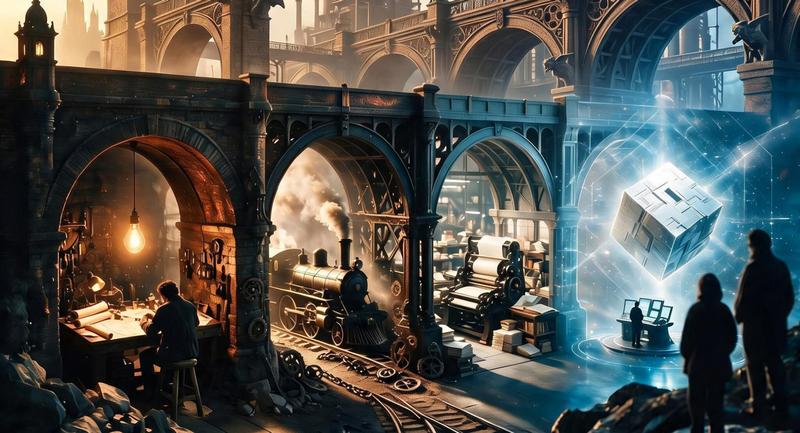
Every age is convinced it stands at the threshold of history's greatest transformation. Most are mistaken.
The Victorians believed the railway would redefine civilisation. Their grandchildren watched electricity perform precisely that feat. A century later, the internet promised to collapse distance and democratise knowledge. It achieved much of that promise, though not always in the ways its earliest champions imagined.
Now artificial intelligence occupies the same place in the public imagination. It is presented as an event so singular that history itself must be divided into a before and an after.
Perhaps.
History, however, has a habit of humbling certainty.
Consider how quickly the conversation itself has moved. Three years ago, the question was whether AI could write a passable paragraph. Two years ago, it was whether it could reason. This year, the debate in boardrooms is no longer about capability at all. It is about autonomy. A majority of enterprise leaders now report running AI agents in production, and the discussion has shifted from "can it do the work" to "how much of the work should it be allowed to do without us."
That is a remarkable change of subject. And almost nobody paused to notice it happening.
The internet altered the movement of information. The smartphone altered our relationship with it. Artificial intelligence is beginning to alter the very act of creating it. And now, with agentic systems, it is beginning to alter the act of deciding as well.
That distinction deserves closer attention than it usually receives.
The Shifting Question

Much of the public conversation remains fixed upon employment. Every week brings another headline asking whether AI will replace accountants, designers, software engineers, solicitors or teachers. This year the medical journals joined in, with a much-discussed piece in JAMA asking whether autonomous systems might eventually outperform not just individual physicians but physician and machine together.
The question is understandable. Employment is tangible. It affects mortgages, livelihoods and families.
It is also incomplete.
The more careful research emerging this year tells a subtler story. AI appears to be changing the mix of tasks inside jobs more than it is eliminating the jobs themselves.
People are using AI to do work traditionally associated with other occupations entirely. Roles are becoming broader, more hybrid, harder to draw a boundary around. The job title survives. What sits beneath it quietly rearranges.
Technological revolutions rarely confine themselves to the occupations they first disturb. They alter the assumptions upon which entire societies quietly depend.
The printing press did not merely produce books more cheaply. It weakened the monopoly over knowledge that institutions had exercised for centuries.
Electricity did not simply illuminate homes after sunset. It reorganised factories, extended working hours, transformed cities and altered patterns of commerce that had remained largely unchanged for generations.
Neither invention changed only what it appeared to change.
Artificial intelligence is unlikely to prove an exception.
The New Scarcity

The real shift may not concern capability at all. It may concern scarcity.
For most of history, expertise was scarce.
A physician possessed knowledge that few others could acquire. A barrister spent years mastering legal reasoning. An engineer accumulated experience that could not easily be replicated. Society rewarded that scarcity because it was difficult to produce and even harder to replace.
Artificial intelligence does not abolish expertise. It alters its economics.
When explanation, synthesis and routine analysis become abundant, the value of simply possessing information begins to diminish.
Something else becomes scarce.
Judgement.
Not judgement in the moral sense, although that matters greatly, but judgement as the ability to decide what matters, what can safely be ignored and what deserves deeper examination.
The evidence for this is already visible, and it comes from an unexpected quarter. Ask the enterprises deploying autonomous agents this year what they want most, and the answer is not more intelligence.
In one recent survey, the overwhelming majority of leaders said stronger guardrails, verification and accountability mattered as much as or more than smarter models.
The engineers, notably, are not the ones applying the brakes. The people slowing things down are those whose entire profession is judgement: risk, compliance, governance.
We built machines that can act, and immediately discovered that what we lack is not action but discernment.
That is not merely a technical finding.
It is a human one.
Capability Vs Judgement

Perhaps this explains why the public conversation often feels strangely unsatisfying.
We continue asking whether machines will become more intelligent, while paying far less attention to what intelligence actually means.
The two questions are related, yet they are not identical.
A calculator performs calculations beyond the reach of any individual. Few would describe it as wise.
A search engine retrieves information with astonishing speed. Few would entrust it with the difficult decisions that define a life.
An autonomous agent can now execute an entire workflow without supervision. Whether it should is a question no benchmark can answer.
Capability has never been synonymous with judgement.
Artificial intelligence may compel us to rediscover that distinction.
History suggests that societies seldom recognise the deepest consequences of a new technology whilst they are living through it. They notice the visible changes first. The invisible ones emerge slowly, almost imperceptibly, until they become impossible to ignore.
Perhaps we are witnessing the beginning of another such transition. The visible change is that machines now act. The invisible one is that human judgement, for the first time in the modern era, is becoming the binding constraint on progress rather than human labour.
If so, the question before us is not simply whether artificial intelligence will replace particular professions.
It is whether we have misunderstood the nature of expertise itself. That seems, at least to me, the more interesting conversation.
Where Euryka Stands
This conversation is not academic for us. It is the reason Euryka exists.
If judgement is becoming the scarce resource, then the tools we build should protect it, not bypass it. That conviction shapes every decision in our platform. Euryka orchestrates the best AI models available, but always within your context: your brand rules, your team's knowledge, your reasoning preserved across every project. The machine accelerates the work. The judgement stays visibly, deliberately human.
It is why we built Brand Hubs that hold your thinking, not just your assets. Threads that preserve why a decision was made, not merely what was produced. Governance that makes every model, prompt and output auditable, because accountability is not a constraint on creativity. It is what makes creative work defensible.
Most AI platforms are racing to remove the human from the loop. We are building the infrastructure that makes the human in the loop more valuable.
If that resonates with how your team wants to work, explore what governed, context-aware AI looks like at Euryka.ai.
Continue the Conversation
The future of AI will not be defined by capability alone. It will also depend on how organisations preserve context, apply discernment and keep people accountable for important decisions. If judgement is becoming more valuable in an AI-enabled workplace, explore how cumulative intelligence raises the value of experts, why AI exposes the structure of creative operations, and how brand language gives AI the context it needs.