
For twenty years, business was taught to admire efficiency, and finance learned to measure it. Inventories shrank, payment cycles shortened, anything not core was outsourced, and capital kept moving. Return on capital rose, margins improved, and balance sheets grew leaner and more admired. Small businesses followed the same advice, usually without the reserves or credit lines larger companies can fall back on. Their returns rose too. So did their exposure.
Then the world stopped behaving. The pandemic gets the blame, but it only revealed what was already there: supply chains stretched thin, geopolitics shifting, energy volatile, and business models with shorter lives. Inflation, rate rises, wars, trade restrictions, cyberattacks, and a new wave of regulation followed. These were not separate shocks but one message delivered repeatedly. The assumptions underneath the modern company were changing, and the company had been built with nothing to spare.
My argument is simple. We did not confuse efficiency with strength by accident. We measured efficiency because it was measurable, rewarded it because markets rewarded it, and optimised away the things that keep an organisation standing when the forecast is wrong.
Why Do Businesses Fail When Efficiency Leaves No Slack?
Silicon Valley Bank was not a story about bad technology or a lost market. It was a story about a balance sheet with no slack: uninsured deposits concentrated in one sector, interest-rate exposure, unrealised losses, each individually survivable, together fatal. The IMF found the same combination at Signature and First Republic. None of the three had become obsolete. They had become fragile, and fragility is what efficiency looks like when assumptions change.
The rest of the economy has the same condition under different names. Manufacturers call it raw-material risk. Retailers call it inventory exposure. Energy companies call it commodity volatility. Hospitals call it cost pressure. The European Investment Bank found that 37 per cent of European firms treat access to commodities and raw materials as a major obstacle, and 34 per cent are hit by logistics disruption. Their response was to hold more stock, add suppliers and invest in tracking.
The small-business version is less visible and more brutal. A bakery with one flour distributor loses a late delivery. The financial version of that story is a week of lost sales against rent, wages and a supplier invoice that still falls due. An independent retailer whose supplier runs short doesn't have an inventory problem; it has a cash problem caused by inventory. Without reserves or a credit line, the gap between the shock and the next receipt is where small businesses fail.
Notice what the responses to all of this have in common: holding more stock, keeping a second supplier, carrying more liquidity. None is innovative. None wins an award. Each makes a company look slightly worse to an investor reading the quarter, and each makes the company harder to break.

Does Finance Optimise for Efficiency at the Cost of Resilience?
Efficiency asks how little a business needs to operate under expected conditions. Resilience asks how much disruption it can absorb when those conditions disappear. Finance has spent two decades perfecting its answer to the first question and largely stopped asking the second.
That is not a criticism of CFOs. Cutting costs, improving margin, tightening working capital, and allocating capital to its best return are the job. The failure is upstream: optimisation became the objective rather than the means, and nobody was paid to notice.
So the company that has removed every spare supplier, cut inventory to the bone, borrowed because debt is cheaper than equity, and deferred maintenance looks superb until the moment it does not. Efficiency and fragility are the same balance sheet read on two different days.
Supply chains make this visible. A manufacturer's primary supplier looks solid. That supplier depends on three smaller firms. One of those depends on a single factory. A problem at tier four stops the line at tier one, and the manufacturer's accounts show nothing until it does. The company is healthy; the system it stands on is not.
The scale changes. The balance sheet logic does not. A company with twelve staff and one with twelve thousand both fail when the gap between a shock and the next receipt exceeds what they hold in reserve.
This is why finance has to start financing systems rather than companies. Supply-chain finance is the obvious case: the buyer lends its credit rating to the supplier, the supplier gets cash earlier, and the bank takes on less risk. The idea is old. What has changed is that it is no longer optional. If a small supplier's failure can stop a large manufacturer, that supplier's balance sheet is the manufacturer's operational risk, no matter what the org chart says.
Why Does Cyber Risk Always Become a Financial Problem?
Cyber makes the same point from a different direction. A ransomware attack on a factory is a production problem. In a hospital, it is a care problem and a revenue problem at once. IBM's 2026 threat intelligence research counted a 49 per cent year-on-year rise in active ransomware and extortion groups, with manufacturing the most targeted sector for the fifth year running and finance and insurance close behind. The US Office of the Comptroller of the Currency now lists cyber and fraud beside credit risk and margin pressure as core concerns for banks. Cyber risk is financial risk; we file it under a different department.
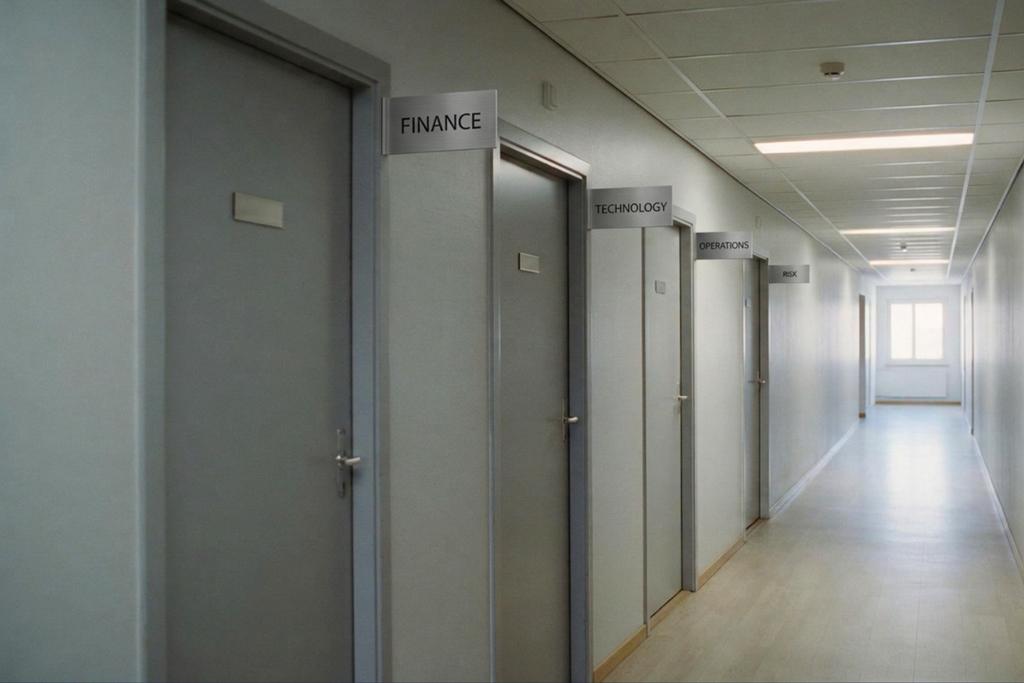
We divide organisations into finance, technology, operations, and risk because org charts need boxes. The world does not use the boxes. A cyberattack becomes an operational problem, then a revenue problem, then a liquidity problem, then a reputational one. A supplier failure becomes procurement, then production, then revenue. A rate shock becomes treasury, then investment, then strategy. The risks were connected all along. Only the departments were not.
What Is Architectural Financial Thinking and Why Does Slack Enable It?
The next phase of financial thinking is architectural. Not how little we can run on, but where our dependencies actually sit. Which suppliers are critical? How concentrated is revenue? How fast can debt be refinanced? What happens if energy doubles or the biggest customer leaves? How much liquidity is real? How long does the business run if a core system goes down? None of this needs artificial intelligence. It needs management willing to ask questions and spend money on answers whose value is invisible while things go well.
For a smaller business, the same exercise fits on one page. Ten minutes with these five questions usually finds the first real exposure:
Who are your top three suppliers, and what are the payment terms if one fails and you have to switch?
Which customers make up more than 20 per cent of revenue, and what happens to cash if one leaves?
How many weeks could you cover wages, rent and suppliers if receipts stopped tomorrow?
How much of your debt reprices or matures in the next twelve months?
Which cost would you cut first in a downturn, and is it the one that prevents the next crisis?
That last question is the whole problem in one line. Resilience is measured by what does not happen. Nobody celebrates the supplier that survived because it had working capital. Nobody announces the attack did no damage because of security bought three years ago. The absence of a crisis never looks like an achievement, so the budget that prevents it is always the first to go.
What Can AI Actually Do to Improve Financial Resilience?
Here is where I part company with most of the current enthusiasm. AI has a real role in this, and it is smaller than advertised.
The useful version is visibility. A model can read every transaction, invoice and contract a business holds, improve cash-flow and demand forecasting, flag fraud, and spot a supplier or customer showing early stress. It can surface connections that would otherwise stay buried across a thousand spreadsheets. It lets a finance team see around the corner.
An algorithm cannot add capital a business does not have. It cannot find a second supplier on its own. It cannot talk a board out of the quarter. It cannot make a fragile company resilient by sitting on top of its dashboard. It is least reliable exactly when it is most needed: the moment conditions depart from anything in the historical data, which is the definition of a crisis. That is when human judgement matters more, not less.
So AI belongs inside the architecture, not at its centre: capital structure, risk management, supplier diversity, insurance, hedging, data and forecasting together. The machine improves some of those. It excuses none of the structural decisions.

Why Do the Strongest Companies Know Where Not to Optimise?
The shift that matters is cultural. Boards need to ask not only what the return is but what happens if the assumption is wrong. CFOs need to think less like accountants and more like architects. Banks need to read the ecosystem around a borrower, not just the borrower. Investors need to learn the difference between a company that is efficient and one that has merely removed every buffer. None of this argues against efficiency. It is an argument against mistaking it for strength.
The strongest companies of the next twenty years will be the ones that know where not to optimise. They will carry liquidity they do not strictly need. They will pay for a second supplier they rarely use. They will fix infrastructure before it breaks and stress-test against scenarios that seem absurd today. On a spreadsheet, they will look slightly less impressive than their peers. They will also be the ones still standing when the spreadsheet is wrong.
For twenty years we made organisations faster and leaner. The more important work now is making them harder to break.
Where Euryka Stands
The businesses we work with are too small for a treasury function and too busy for a resilience committee. They are growing companies where buffers are thinnest and dependencies least visible: cash reconciled at month-end rather than watched through the week, a forecast nobody rolls forward, a customer concentration nobody has measured, a roster held in one head, a supplier nobody has priced an alternative for. Our job is the architecture question at that scale. We build one layer on top of what a business already runs, across finance, operations, sales, marketing, and people, so the forecast rolls forward, exceptions surface early, and dependencies are written down rather than remembered. The machine does the watching. Decisions about what to carry, what to protect, and where not to optimise stay with the people who understand the business, and we stay beside them to keep asking uncomfortable questions.

How Can Euryka AI Help Fix Hidden Operational Dependencies?
If your business looks more efficient on paper than it feels in practice, we would like to hear about it. Bring the dependency that would hurt most if it failed. That is usually where we start.
Sources and Further Reading
The arguments in this piece draw on research from the IMF, the European Investment Bank, the Federal Reserve, the US Office of the Comptroller of the Currency and IBM, among others. Key references:
International Monetary Fund, The US Banking Sector since the March 2023 Turmoil: Navigating the Aftermath, Global Financial Stability Note 2024/001 (March 2024)
European Investment Bank, Navigating Supply Chain Disruptions: New Insights into the Resilience and Transformation of EU Firms (October 2024)
US Office of the Comptroller of the Currency, Semiannual Risk Perspective, Spring 2025
IBM, X-Force Threat Intelligence Index 2026 (February 2026)
Federal Reserve, Financial Stability Report (most recent edition)
International Monetary Fund, Global Financial Stability Report (most recent edition)
International Monetary Fund, United States: 2026 Article IV Consultation, Country Report 26/76 (April 2026)
The Conversation Continues
These questions continue in our essays on why imagination becomes more valuable as AI advances, how AI-native expectations are reshaping the workplace, and why predictions about artificial intelligence often miss the mark: