
Hospitality has plenty of AI. What it lacks is AI that matters.
That is the uncomfortable finding at the heart of our new white paper, The Experience Advantage: How Hospitality and Tourism Leaders Can Make AI Useful Across the Guest Journey. The industry has recovered its demand. International arrivals reached roughly 1.52 billion in 2025, and Travel and Tourism contributed an estimated US$11.6 trillion to global GDP. People are travelling again, enthusiastically.
Yet the numbers behind the numbers tell a different story. McKinsey found that while 90 percent of surveyed travel organisations were using generative AI in some form, only 2 percent reported widespread, mature deployment. PwC found nearly the same pattern in the Middle East: 91 percent piloting, 3 percent at enterprise scale.
In other words, hospitality does not have an AI awareness problem. It has an AI usefulness problem.
How Does a Fragmented Guest Journey Cost Hotels Revenue and Loyalty?
Consider how a guest actually arrives at your door in 2026. They discover a destination through a short video, research it with an AI assistant, compare prices across three booking platforms, read reviews on two more, message your property on WhatsApp, and book through whichever channel felt least painful at eleven o'clock at night.

Each touchpoint is owned by a different system, team or third party. Marketing knows one version of the guest. Reservations knows another. The front desk often meets them armed with little more than a name and a room number. The loyalty programme knows what they spent, but not what they actually valued.
Guests experience one journey. Most hospitality businesses still manage several disconnected ones. That gap is where relevance, revenue and repeat bookings quietly leak away.
Why the Pilots Keep Stalling
The white paper identifies a familiar pattern. A chatbot is added to the website. A content tool is adopted by marketing. A copilot lands at head office. Each solves a task. Each creates a new island.
The chatbot does not know what marketing promised. The content tool does not know what the brand approved last quarter. The copilot drafts an email the property team rewrites because it sounds like nobody in particular. Meanwhile governance arrives at the end of the process, checking work after it has been produced, which in an industry built on trust is precisely the wrong order.
An AI pilot can look impressive in a presentation and still make little difference at reception.
How Does the Euryka Guest Journey Framework Protect Trust at Every Stage?
The paper's answer is the Euryka Guest Journey Framework: four connected stages, with trust protected at every one of them.

Attract with relevance. Being found, understood and preferred across search, social, travel agencies and, increasingly, AI assistants. This demands accurate, distinctive, multilingual communication at a volume most teams cannot sustain by hand.
Convert with confidence. Closing the distance between interest and booking with fast enquiry responses, sharp proposals and direct offers compelling enough to compete with the convenience of third parties.
Serve with context. Giving frontline teams the information they need in seconds, so the front desk is never the least informed voice in the conversation. The employee remains the interface. The system simply makes them sharper.
Retain through continuity. Treating departure as the start of the next booking, with post-stay communication that remembers the actual stay rather than a segment code.
Each stage runs on the Euryka Platform, where the Brand Hub holds the single source of truth, Threads keep team collaboration in context, Flows turn repeatable campaigns into reusable pipelines, and Imaginations, Documents and Voiceovers handle the creative volume. Euryka AI Studio wraps expertise around it all, from mapping your journey to building bespoke automations and staying embedded as the capability matures.
Does AI in Hospitality Make Staff More Human or Less?
The most important argument in the paper is also the simplest. The goal is not to automate hospitality. It is to remove the work that gets in the way of hospitality.

Hospitality has always been the business of noticing: what a guest needs before they ask, when a routine has become a ritual, the difference between a complaint and a cry for reassurance. No technology replaces that. What technology can do is ensure your organisation acts on what it notices consistently, across every property, channel, language and shift.
The organisations that win will not automate every interaction, and they will be rightly unimpressed by anyone suggesting they should. They will choose the places where AI removes friction, sharpens relevance or returns time to the people who serve. That is the experience advantage.
Where to Start
Start with a business bottleneck, not an AI wish list. Where is guest context being lost? Which repetitive tasks are consuming the hours your teams would rather spend on service? Which systems need to connect? What controls do you need before you trust the output?
If you cannot answer those questions confidently, the white paper offers a practical way to begin, including a five-dimension readiness view and a phased path from Decode through to Govern.
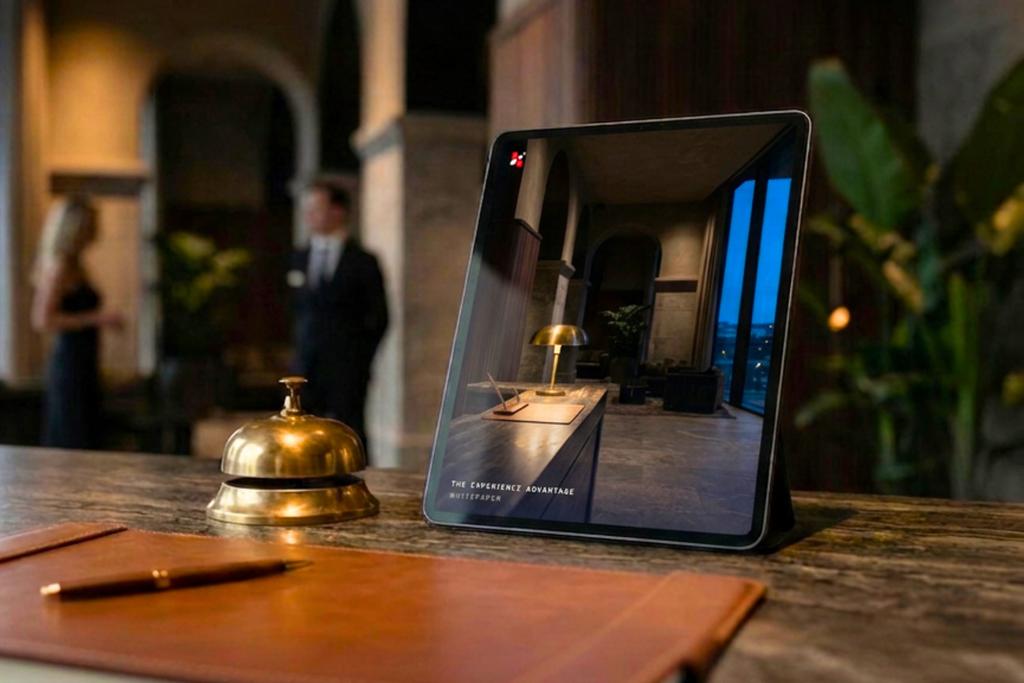
Read the Full White Paper
Read The Experience Advantage to explore the complete framework, the segment-by-segment view of where AI creates value across hotels, tour operators, destinations, platforms and events, and the practical five-phase path from pilot to dependable capability.
Or go one step further. Book a Hospitality AI Readiness Assessment with Euryka, and we will help you map where guest context is being lost, which workflows create avoidable effort and which use cases belong in your first 90-day activation plan.
Better hospitality does not begin with more technology. It begins with knowing where technology genuinely helps.
Where the Same Challenge Appears Next
As brands grow across channels, teams and markets, protecting a consistent customer experience becomes harder. Scaling Creative Production Without Losing Your Brand’s Point of View explores how a Brand System keeps creative judgement consistent as output expands.
In food and beverage, product claims, localisation and retail demands add further complexity. Fast Food. Slow Brands. examines how F&B brands can protect their character across packaging, digital, retail and international markets.