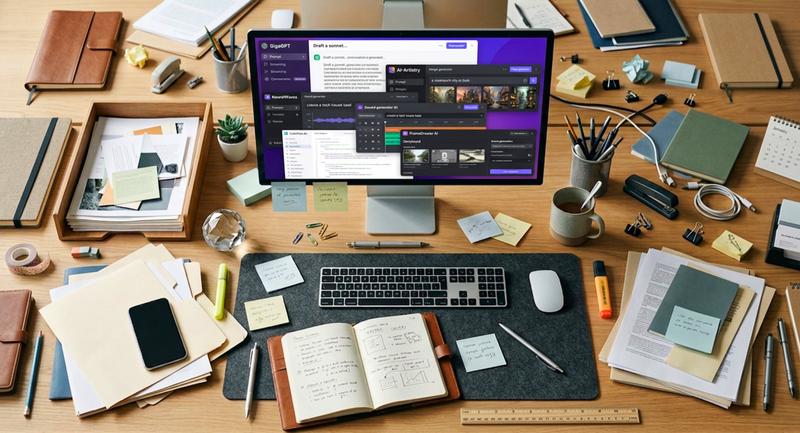
When execution becomes cheap, what is a professional actually worth?
There is a strange contradiction at the heart of the conversation about AI and work. We spend an enormous amount of time talking about which jobs artificial intelligence will replace, yet when you look at what people actually do for a living, remarkably little of the underlying human need has changed. Businesses still need people who can understand customers, solve problems, make decisions, build things, explain complicated ideas and persuade other people to care about them. What is changing, quite rapidly, is the machinery around that work.
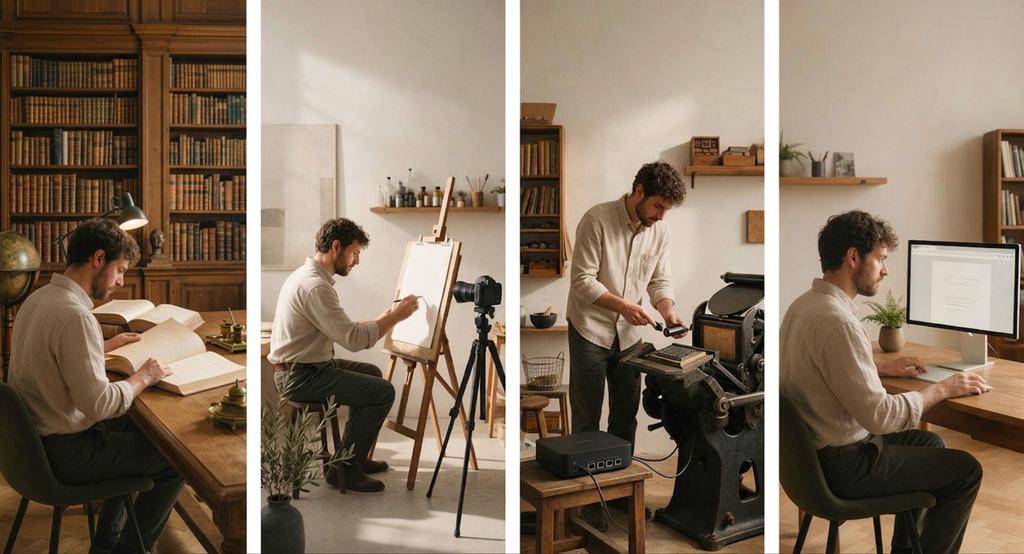
Technology has always done this. The spreadsheet did not eliminate accountants, the camera did not eliminate painters, the internet did not eliminate newspapers and search engines did not eliminate researchers. Each changed how the work was performed and, in some cases, changed the economics of an entire profession, but the underlying need remained. AI is likely to do much the same, although the speed at which it is happening makes the change feel more dramatic.
How Is AI Changing the Value of Professional Skills?
A lawyer still has to understand a client and construct an argument. A designer still has to decide what something should communicate. A marketer still has to understand why somebody might buy something. A researcher still has to decide which questions are worth asking.
AI can increasingly help with the journey between the question and the answer, but it has not made the question itself any less important. If anything, the quality of the question is becoming more consequential.
A writer can now produce ten possible openings before breakfast, a designer can explore dozens of visual directions in the time it once took to develop one, and an analyst can ask a model to sift through information that would previously have taken days to process. The first version has become cheaper; knowing what deserves to become the final version has not.
That is where skills enter the picture.
For years, professional expertise was partly protected by the difficulty of execution. If writing well took years to learn, the ability to write well had an obvious economic value. If analysing a large body of information required considerable time and technical knowledge, the person who could do it had an advantage. AI is beginning to remove some of that friction, which is both liberating and slightly uncomfortable because being able to perform a task is becoming a less reliable measure of expertise.
If almost anyone can produce a competent first draft with the help of a machine, competence has to reveal itself somewhere else. It appears in the ability to frame the problem, recognise a weak answer, understand context and make a decision when the available information is imperfect.
The valuable person will increasingly be the one who knows when to use the machine, when not to use it and what to do with the result.
How Fast Are the Skills Inside a Job Title Actually Changing?
The labour market is already giving us evidence that the real change is happening at the level of skills rather than occupations.
LinkedIn estimates that 70 per cent of the skills used in most jobs will change by 2030, while the World Economic Forum estimates that 39 per cent of workers' existing skill sets will be transformed or become outdated between 2025 and 2030.
The methodologies are different, but the direction is remarkably similar: the work is changing faster than the labels we have traditionally used to describe it.
A marketer does not become obsolete because AI can write copy. The marketer's job simply contains a different balance of activities. There may be less time spent producing words and more time spent understanding customers, shaping positioning, interpreting culture and deciding which ideas are commercially meaningful. The same thing is happening across design, research, programming, finance and a growing number of other fields.
This makes the idea of a skill stack more useful than the idea of a fixed professional identity.
Someone who combines design with psychology, research with data, strategy with technology or writing with business understanding can move across changing environments because the underlying capabilities are portable.
The particular tools may come and go, but the ability to understand people, interpret information, solve problems and make good decisions travels surprisingly well.
A job belongs to an organisation. A profession belongs to an industry. A skill belongs to the person.
That portability may become one of the most valuable forms of career security.
AI May Make Expertise More Important
There was an assumption in the early conversation about AI that once machines became sufficiently capable, human expertise would become less valuable. The emerging evidence is more complicated.
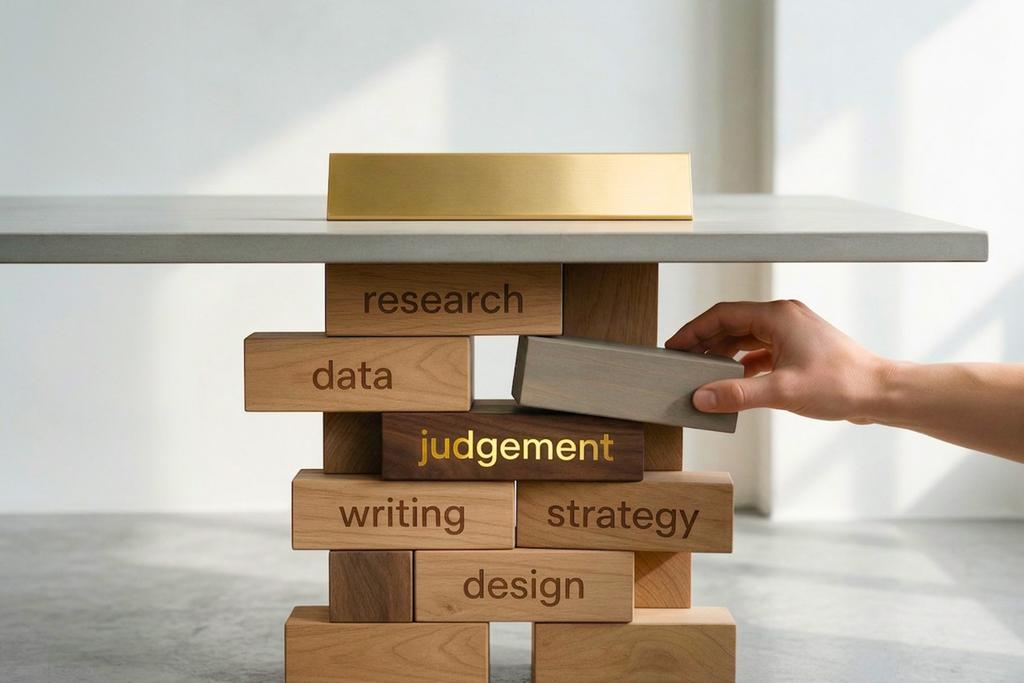
PwC's 2026 Global AI Jobs Barometer found that the skills required in the most AI-exposed jobs are changing more than twice as quickly as those in less exposed jobs, while new tasks appearing in those roles are increasingly associated with judgement, creativity and leadership.
The logic is fairly straightforward.
If the machine takes over more of the routine work, the human being moves towards the decisions surrounding that work.
The analyst spends less time cleaning information and more time interpreting it; the designer spends less time producing variations and more time deciding which direction is worth developing; the writer spends less time assembling sentences and more time shaping an argument.
There is, however, an awkward consequence. Some of those routine tasks were also how people learned. The junior employee who spent two years doing the unglamorous work was not simply providing cheap labour; they were gradually acquiring the judgement that allowed them to become senior. If AI removes the apprenticeship tasks, organisations will have to become more deliberate about how people acquire the experience that machines cannot provide.
That is a much more interesting problem than whether AI will replace the junior employee.

How Does the Ability to Learn New Skills Future-Proof Your Career?
This is where the idea of skills as currency becomes more useful than the idea of AI as a currency in itself. A particular model will become obsolete, a software platform will be replaced and a workflow that seems revolutionary today will eventually become an ordinary feature of workplace software. Building a career around any one of these things would be rather like building a career around knowing how to use a particular version of Microsoft Office.
The more durable asset is the ability to learn what comes next.
The World Economic Forum continues to identify analytical thinking, creative thinking, resilience, flexibility and agility, leadership and technological literacy among the skills expected to remain important as work changes.
None of these is particularly new, which is precisely the point. The future may not require a completely new category of human being; it may require people who become better at capabilities we have always needed, while learning how to apply them in an environment where machines can do considerably more of the execution.
This also changes the way we think about education.
A qualification remains valuable, particularly where deep domain knowledge is essential, but the idea that education happens first and work happens afterwards is becoming increasingly difficult to sustain.
If the tools change throughout a career, learning becomes part of the career rather than preparation for it.
What Is the Real Currency in the AI Economy?
Eventually, asking whether someone uses AI will probably become an odd question. It will simply be part of how most professional work gets done, just as computers, search engines and software are now so ordinary that we rarely think of them as technologies we have “adopted”.
What will remain interesting is what the person can do with all that additional capability.
That is why skills are becoming the new AI currency. Not because AI has made knowledge irrelevant, and not because everyone needs to become an AI specialist, but because AI is making execution easier to access.
When more people can produce something, the ability to produce it becomes less distinctive; the ability to understand what is worth producing, why it matters and how to make it work becomes considerably more valuable.
Perhaps the real shift in the AI economy is therefore not from people to machines, but from one definition of expertise to another.
The jobs are likely to remain more familiar than the headlines suggest. The work will continue to be done. What changes is the combination of skills required to do it well.
Where Euryka Stands
This is the assumption Euryka is built around. Growing businesses do not necessarily lack intelligence; they often lack the people and capacity to apply it consistently across the business. Euryka sits in that gap, working as an additional layer across finance, operations, sales, marketing and people, using AI for the execution it is good at while keeping business judgement with the people who understand the context.
The important part is not the technology itself, but the combination of technology and human judgement. The machine can take on more of the execution, while the decisions that require context remain with the people who understand the business. Processes and judgement become part of the organisation rather than disappearing when one person leaves.
That is ultimately what the changing value of skills is about.
AI can increase the amount of work a team can handle, but it does not remove the need for someone who understands why the work matters, what should happen next and what should never be automated in the first place.

How Can Euryka Studio Help When Your Team Can’t Keep Up?
If the work is growing faster than the team, and the hire that would fix it is hard to justify, we would like to hear about it. Bring the process that costs you the most time, and that is usually where we start. Discover how Euryka Studio can help or ask what we can do for you.
Further Reading
These themes are examined further in Intelligence Is Becoming Abundant. Imagination Is Not., They Grew Up With AI. Your Workplace Did Not. and Why Most Predictions About Artificial Intelligence Miss the Mark. Read the full collection for perspectives on work, creativity and the future of AI.